
Evaluating the Impact of AI on the Labor Market: September CPS Update
Key Takeaways
-
While the occupational mix is changing more quickly than it has in the past, it is not a large difference and predates the widespread introduction of AI in the workforce.
-
Currently, measures of exposure, automation, and augmentation show no sign of being related to changes in employment or unemployment.
-
Better data is needed to fully understand the impact of AI on the labor market.
-
We plan on updating this analysis regularly moving forward to see how the impact of AI on the labor market changes over time.
The addition of the September CPS does not suggest any substantial changes to the analysis TBL released in early October. Overall occupational dissimilarity, industry dissimilarity, and our exposure and usage metrics all remain flat or continue along the trends they were already exhibiting. However, changes in the dissimilarity between recent and older graduates exhibit some behavior worth highlighting.
The dissimilarity between recent and older college graduates decreased by .7 percentage points between August and September, likely a seasonal pattern. This could be explained by more of the workers entering the workforce for the first time finally finding employment after several months of searching. This finding also emphasizes the volatility in these data.
Overall, the September CPS release does not indicate a meaningful shift from August in most categories. There may be some signs of longer duration of unemployment for more exposed workers, but it seems more likely to reflect volatility in the data.
Of course, our analysis is not predictive of the future. We plan to continue monitoring these trends monthly to assess how AI’s job impacts might change. It is important to remember that the effects of new technologies are evolving, and a simple snapshot in time is not enough to explicitly determine what the future holds.
Is this Time Different? Changes in the Occupational Mix
The job mix for AI appears to be changing faster than it has in the past, although not markedly so.

However, shifts in the occupational mix were well on their way during 2021, before the release of generative AI, and more recent changes do not seem any more pronounced, even as the use of AI continues to grow in popularity.

Repeating this analysis by industry similarly suggests a limited effect of AI.


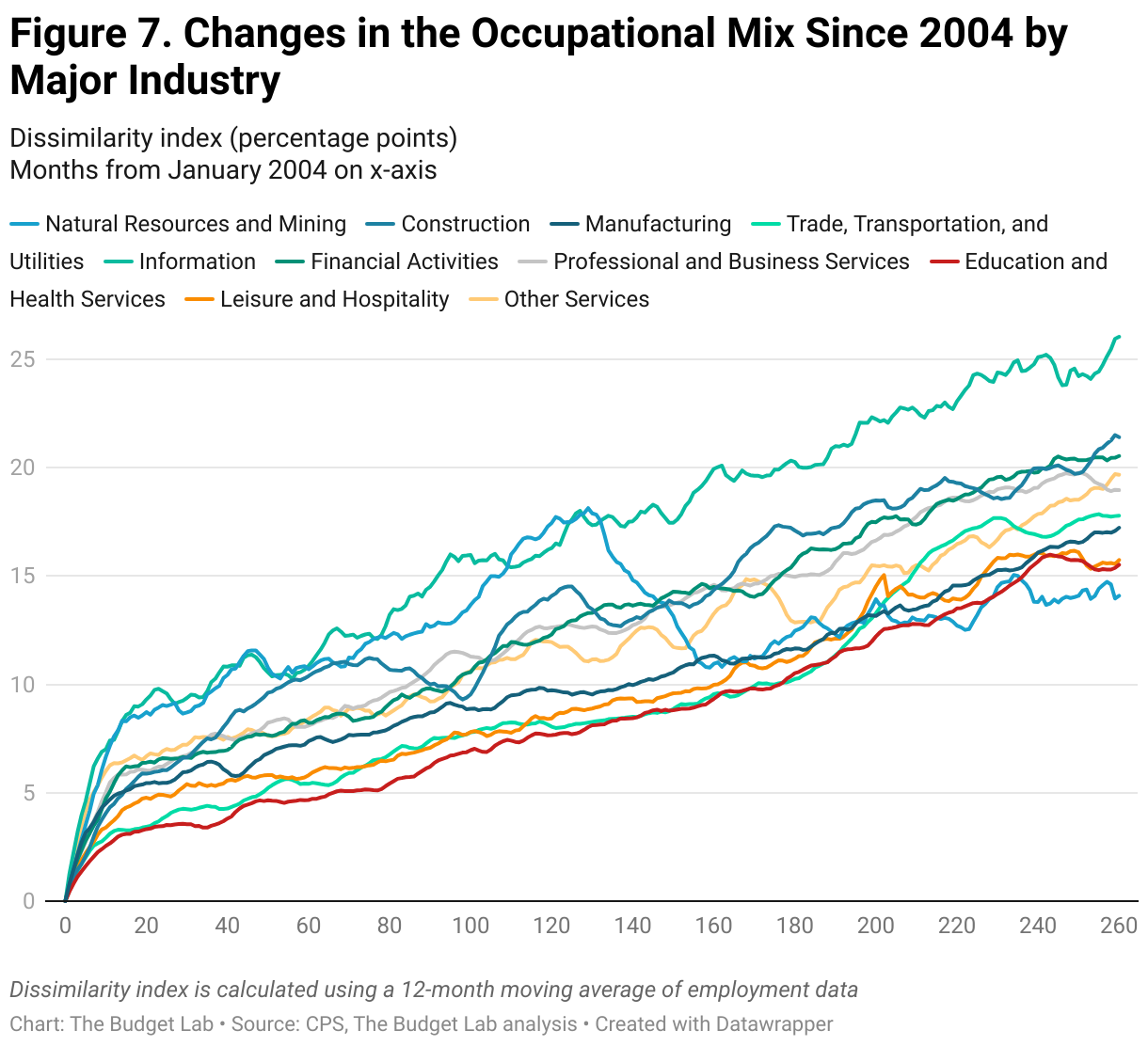
The dissimilarity data we have examined indicates that there is no substantial acceleration in the rate of change in the composition of the labor market since the introduction of ChatGPT. Lacking that, there is nothing meaningful we can either attribute or misattribute to AI.
Recent College Graduates
Figure 8 compares the occupational mix for recent college graduates (ages 20-24) to that of their older counterparts (ages 25-34). If generative AI were in fact substantially changing the labor market for recent college graduates, we would expect to see a growing dissimilarity in the occupational mix between these two groups. However, our results should be interpreted with caution particularly given small sample sizes. Dissimilarity appears to have decreased in September, likely a seasonal pattern and an important reminder of the volatility in these data.

Taking a closer look at the trend since January 2021, the dissimilarity between older and more recent college graduates rarely deviates outside of the 30-33% range (Figure 9). Further, the same caution in interpretation given the small sample sizes holds in this figure as well.

Insights from AI "Exposure" and Usage
To better understand whether AI is impacting the labor market, we would want to analyze whether the share of workers in occupations that are most impacted by AI usage is changing over time. If AI were automating jobs at scale, we would expect to see a smaller share of workers in some of the jobs that are most negatively impacted.
We use data from OpenAI and Anthropic, respectively, that detail the occupations that are most “exposed” to genAI tools (a theoretical, forward-looking metric across all jobs) and that have the highest actual usage of one specific AI tool, Claude (a more narrow, present-focused metric). While imperfect, these data are an approximation of AI job “risk”. (See discussion of limitations in the original analysis.)
Importantly, OpenAI and Anthropic are measuring different things and we look at them separately.
OpenAI's "Exposure" Data
We ask: has the share of workers in occupational exposure quintiles changed since ChatGPT’s launch? Our analysis shows that it has not (Figure 10). The share of workers in the lowest, middle, and highest occupational exposure groups stay stable.

Even when specifically examining the unemployed population, there is no clear growth in exposure to generative AI. Figure 11 depicts the average percentage of tasks exposed amongst unemployed workers by duration of unemployment. AI-driven displacement might suggest a growth in the proportion of exposed tasks amongst recently unemployed workers. Irrespective of the duration of unemployment, however, unemployed workers were in occupations where about 25 to 35 percent of tasks, on average, could be performed by generative AI. Although there is some variation between months, the data demonstrate no clear difference by the duration of unemployment.


Anthropic's Usage Measure
Anthropic’s data on AI usage shows similar trends of stability over time, rather than disruption. The proportion of employment in occupations with high levels of task AI usage, whether automation or augmentation is generally stable (Figure 14). Repeating a similar analysis as above, Figures 15 and 17 report the occupation-level share of tasks that are automation or augmentation, respectively, amongst unemployed workers by duration of unemployment. Note: for this analysis, we use Anthropic’s most recent data on AI usage, which was released in mid-September.


Summary
While anxiety over the effects of AI on today’s labor market is widespread, our data suggests it remains largely speculative. The picture of AI’s impact on the labor market that emerges from our data is one that largely reflects stability, not major disruption at an economy-wide level. While generative AI looks likely to join the ranks of transformative, general purpose technologies, it is too soon to tell how disruptive the technology will be to jobs. The lack of widespread impacts at this early stage is not unlike the pace of change with previous periods of technological disruption. Preregistering areas where we would expect to see the impact and continuing to monitor monthly impacts will help us distinguish rumor from fact.